Along came a spider

spider2

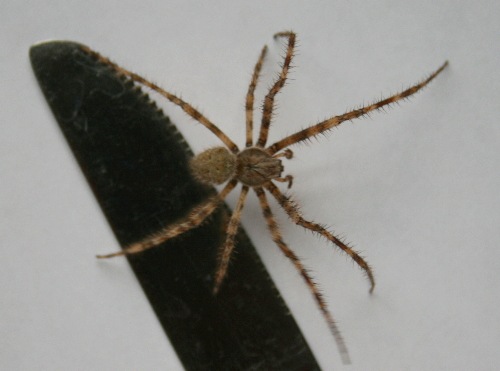
Late last week we received a visit from this spider, which Dan discovered on the silverware in the drying rack while he was washing dishes. I gather it appeared out of nowhere and caught Dan quite by surprise, not least of all because of its size. Though it’s mostly all leg, it’s still impressively large. He carefully saved it in the fridge for me, and I did my best to push aside my squeamishness over spiders (one of the few groups of invertebrates I get that way around) to take a few photos. I moved him out to our woodshed once I was done, where I felt his presence was more appropriate.

The spider is male, which I could immediately tell by the two short, round projections at its front; these are its pedipalps, which are modified mouthparts the male spiders use to transfer sperm packets from their own abdomen to the female spider during mating, so females don’t have them. Considering that female spiders are most often noticeably larger the males, it left me wondering just how big the females of this species must be.

spider1

I didn’t know the species right away, despite the size of this guy, and so spent a while flipping through pages on BugGuide. For all that I can ID our local birds with a glance or quickly guess the families, if not the species, of most of the moths and butterflies and dragonflies I encounter, when it comes to spiders and some other groups of insects I’m back to being a novice again. My identification method usually becomes scanning the photos associated with each family, looking for something that might be similar. Usually I end up checking out half a dozen families, sometimes more, looking for a photo of an individual that seems to match mine. Most of the time I can reach an ID, though it can be time-consuming.

Despite what would seem to be a very distinctive individual, given the size and those bristly legs and the interesting rayed-circle pattern on the thorax, I didn’t come up with a conclusive identification for this guy; but I’m leaning toward Cross Orbweaver, Araneus diadematus.

Normally I think of the orbweavers as having huge, spherical abdomens, so the family didn’t immediately cross my mind for this one. But it’s the females that look like that; the males are slimmer. What prompted me to check that family for photos was the short third pair of legs. I’ve come to think of this as a defining feature of the orbweaver family, but I can’t see anything to say that’s true. Defining or not, it is still a feature, however; those shorter third legs are modified for use in building the stereotypical spiderwebs the group is known for.

Araneus diadematus - Garden Spider
Araneus diadematus - Garden Spider by Camponotus Vagus, on Flickr; CC-licensed

The Cross Orbweavers are a very big species; BugGuide gives the average measurement as 13mm (1/2″), and that’s just the body. Once you add legs to that, you’ve got an impressively large spider. Check out this male and female of the species, above, then compare to my top image with average-sized butterknife. As I checked out the page for the species, I recalled some massive female orbweavers that hung around the covered walkway along the back of our house, where I set out my moth trap. I unfortunately seem not to have taken any photos of them, so I can’t be sure they were the same species.

Araneus diadematus
Araneus diadematus by Astroblue, on Flickr; CC-licensed

The Cross Orbweaver’s name comes from the white cross on its abdomen, which my spider lacks; the species is variable, however, and I’m not sure whether the lack of a cross on mine is due to the variability of the species, or the fact that I’ve misidentified it. ;)

The records on BugGuide are nearly all late summer and fall, right into November for Ontario. It’s only found in northeastern and western North America; like so many of our species, it’s a European introduction. It goes by the name European Garden Spider in its native range and is, unsurprisingly, a common resident of gardens.

I gather orbweavers are very docile spiders, slow to bite, and with a preference for flight rather than fight. I did in fact have some trouble getting this one to sit still for me, but I had no inclination to put out my hand to stop him. It’s not that I fear being bitten – the bite is supposedly no more painful than a bee sting – as much as it is just the creep factor of having a spider walking over me. If this was a moth, however, or a beetle or praying mantis or walking stick, no problem. But just can’t do with with a spider.

One last interesting fact: orbweavers are mostly nocturnal. During the day they’ll either hang out on their web, or in a bit of cover such as a rolled-up leaf nearby, only coming out to immobilize trapped prey. At night they return to their web, rebuilding any damaged sections. A few species actually ingest the remains of the old web and build an entirely new one from scratch. I recall watching one of the large females actively building a web one evening while I was checking my moth sheet, though whether she was repairing or building fresh I couldn’t say.

Bald-faced Hornet nest

hornet1

While out walking the other day I discovered a huge paper wasp nest attached to the bottom branches of one of the small bur oak saplings in our meadow. I brought my camera today when I went out to get some photos as I did some investigation.

The nest was gigantic, by my sense of wasp standards. I’m used to the little Polistes nests that hang from the ceiling of your garage and such; they rarely get much bigger than a fist, though some particularly enthusiastic colonies might manage to produce one that’s cantaloupe-sized. But this was huge; bigger even than my head. Half the size of Jack. Probably a good 14 inches (35 cm) top to bottom.

hornet2

The lower branches and leaves of the sapling had been completely integrated into the structure of the nest. I don’t often see wasp nests in trees, but I’m pretty sure that all the ones I’ve seen previously hung by a peduncle and didn’t incorporate any tree bits.

It seemed funny that I hadn’t noticed this at all during the summer, but the grass gets quite long and it would’ve been well-hidden; I would probably have needed to walk right past the sapling to have seen it before the grass began to die back. Even now, from the main trail it was still hard to detect.

hornet3

Feeling fairly comfortable in the knowledge that paper wasps don’t overwinter in their nests, I decided to open it up. I still used a stick to do it – I wasn’t feeling that confident – but my suspicions were confirmed: the nest was empty. At the end of the summer, the entire thriving colony dies with the frost. Only the new queens, which have already gone on mating flights and been fertilized, overwinter. Next spring they’ll emerge and start building a new nest, tending the eggs themselves until the first brood of workers are grown and able to start helping out.

It’s interesting to see all the layers of paper around the exterior of the comb. These provide not only protection against the elements but also thermoregulation; all those narrow pockets of air act as insulation, helping to keep the inside of the nest cool even in the summer heat.

hornet5

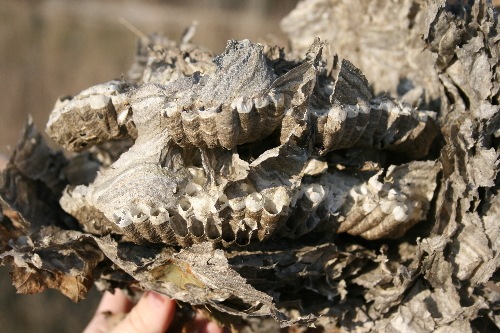
I pulled the comb out from the center to have a closer look. It turned out to be two layers thick, with the second layer separated by a gap of about a centimetre (1/2 inch) or so. Each cell was about 3/4 inch (almost 2 cm) deep and perhaps 1/3 inch (8 mm) across. I’m looking at those cells and thinking: these were big wasps, whatever they were. The cells in typical Polistes nests aren’t that big.

All of the cells were empty. The paper that made up the walls of the cells was thin and somewhat brittle, but the two combs seemed to have a reinforcing network of stiff paper arches bracing one comb against the other. You can see a couple here, on the left, looking like swirling flat pieces of paper tucked into the middle of the comb. The ones on the top I don’t think served any purpose yet; I think they were built in preparation for another third comb to be added, but the approach of winter cut short construction.

hornet4

I love the paper created by paper wasps. It’s so firm, but you can see each layer of pulp that was added to form the wall. The paper is grayish but the tones and hues vary depending on the source of the pulp: some quite pale, some dark, some reddish or yellowish. About 2 mm (1/8 inch) wide and up to an inch (2.5 cm) or more long, each wall is made up of hundreds of trips to scrape wood fibers from dead wood. (This may include your deck or pieces of untreated plywood around your home.)

hornet6

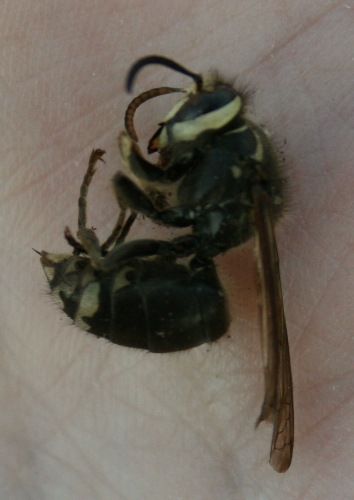
In the very bottom of the nest I discovered a single dead individual, the only one left, caught in a fold of the paper. The identity of the nestmakers revealed: they were Bald-faced Hornets, Dolichovespula maculata. Actually a type of yellowjacket, I believe it’s the only native North American wasp with the common name “hornet”. True hornets are members of the genus Vespa, of which there is only one in North America, the introduced European Hornet (Vespa crabro).

Most of the yellowjackets do have a lot of yellow on them, but there’s one species that’s mostly dark and commonly called a Blackjacket. So maybe this would more aptly be called the Bald-faced Blackjacket? The “bald-faced” part, of course, refers to the pale forehead and face (bald being an old english term for this, still often used in describing animals, especially horses).

Check out the stinger at the end of the abdomen. I was very careful while I handled it, just in case. ;)

Scotch Pine wasps

Scotch Pine

This Thanksgiving weekend Dan and I returned to the Toronto area for dinner with his family. The weather was gorgeous, and while there we took the dogs for a walk to a bit of natural habitat just down the road. The house is in a suburban area but backs onto a nice patch of woodland habitat, one of the largest such patches in the immediate vicinity, so there’s often some interesting goings-on there. I heard Carolina Wrens, which don’t really occur out here (they’re rare and very local), and Red-bellied Woodpecker which is also rare this far east but relatively common there. We have Northern Cardinals here but they’re sparse and in low numbers; down there, you hear them nearly every time you step out.

Despite that, there wasn’t a lot of time for naturalizing, but I did pause to ponder this tree when I came across it in a small meadow. It wasn’t the tree that caught my interest so much as what was going on with it: it was crawling with wasps. (The tree itself is a Scotch Pine, a non-native species that’s often planted in plantations or urban areas because it’s hardy and fast-growing. This one seems to have planted itself naturally.)

Yellowjackets on Scotch Pine

It’s a shame my camera doesn’t do video, because only video could have captured the numbers of wasps really well: the branches were alive with them, crawling between the needles and flying from one spot to another. There are seven wasps in this photo alone – multiply that by so many branches. I presumed that they were all converging on this tree because it was exuding sap for some reason, perhaps the way new buds are sticky to the touch. I wasn’t keen to stick my hand into the branches to find out if the twigs were sticky, however, so I just took a number of photos and then hurried to catch up with Dan, who by that time had made it halfway across the meadow.

Yellowjacket with scale insects

But when I got home and started looking more closely at the photos, I noticed small brown bumps on the twigs. On some of the twigs, but not all of them. And the twigs with the most wasps seemed also to have the most bumps. Coincidence?

Some poking about Google and a quick reference of my Tracks and Sign of Insects, and I think I have an answer. I suspect these bumps to actually be scale insects, which are usually small, featureless domes scattered along twigs. They could be Pine Tortoise Scale, Toumeyella parvicornis, which is small and reddish and includes Scotch Pine among its targets. Like aphids, as they feed scale insects will produce honeydew, a sweet secretion resulting from their diet of sap. This honeydew, in turn, is very attractive to nectar-feeding insects such as bees and wasps.

Spider wasp sp.

The most common species of wasp on the tree was Eastern Yellowjacket, but I noticed at least one other yellow-and-black species, one mostly black species with a single yellow band, possibly two species of metallic green sweat bee, and the above, which I think is a species of spider wasp (family Pompilidae), though none of the ones shown in my Kaufman Guide to Insects or in the group’s photos on BugGuide seem to match. The Kaufman Guide does note about the family, though, that “Many visit aphid colonies for honeydew secreted by those insects.” Also present on the tree were quite a number of ladybugs. Ladybugs may be interested in the honeydew, but are probably there to feed on the scale insects themselves.

During the break…

leaf

During the break…

…I’ve been hard at work on the moth proofs. I’m at 45 hours (and counting) spent bent over my drafting table, red pen in hand. Most of these hours have been spent in drawing in the arrows that I dearly hope all you good folks are going to make effective use of in identifying your unknown moths. Doing it forced me to really pause and think about what features I refer to when I recognize a species, how it is I know a species is what it is and not something similar. I’ve learned some interesting and, on occasion, surprising things about the identification of even the moths I’m already familiar with.

White Underwing

…I’ve been setting out my moth light most nights it’s warm and dry enough. Trying to lure in some interesting species so I can take their photos to include among the selection we’ll send to our book’s designer for use on the title pages. We sent them some already, but they turned out to mostly be the wrong orientation. A few nights ago I had some eight underwings come in, half of which were White Underwings like this guy.

leaves

…the leaves have been turning. In the past few years our autumn colour has peaked around Thanksgiving weekend, which here in Canada is the second weekend of October. Next weekend, this year.

fall trees

But it feels like our trees have already peaked. There were vibrant colours among our fields last week, which I’d appreciate when I took the dogs out for some exercise and so I could straighten my back for a brief period.

fall maple

I wonder if it’s because of how dry and sunny it’s been this year? There seem to be a whole lot more reds than there were the year before. The maples in our yard have turned fairly orange, but last year they seemed more yellow (though maybe it’s my imagination). Reds are controlled by light levels and temperatures (I explained the process in more detail in this post), with bright, cool days producing the most colour, so perhaps. The cool weather has definitely arrived, though we managed to hold off our first fireplace fire (the sole source of heating for our home) until October 1, which I thought was doing better than usual.

Milkweed snow

…the milkweed has peaked, too. We had a stretch of beautiful sunny days where all the pods seem to split and the fluffy seeds puffed out, waiting to catch the wind. I couldn’t resist kicking at the stalks as I passed, spreading the down in a snowy blanket across the grass.

Tiny Woolly Bear

…and the Woolly Bears have started trundling from the plants where they grew up to look for a spot to spend the winter. This has got to be the tiniest Woolly Bear I’ve ever encountered. I presume he’s very young, relative to most of the ones I find. I hope he finds someplace cozy

Mantids

Praying Mantis and underwing

There haven’t been many moths to my light the last few times I’ve set it out, even on the warmer, humid evenings. Something to do with the weather, maybe? The almost-drought from earlier this summer? I dunno. But what I did have a lot of one night were these guys. Praying mantises. At the point that I finally shut the light off and went to bed, well after midnight, I’d managed to attract 13 of them. Several clung to the sheet, others clambered up the log wall, one or two walked along the ground below the light. Equal numbers of both green and brown. I never saw any of them stalking (or holding) prey, though they did occasionally turn their heads to watch a moth walk by… like this one is doing. I love how mobile their heads are.

Praying Mantis

I did a post about praying mantises a couple of years ago, the first summer we moved here. They’re abundant in our fields, and late August through September seems to be when the adults start taking wing. Which is mostly when I notice them. Mantises go through a simple metamorphosis, meaning that the larval/nymph stages look very similar to the adults, but without wings. Grasshoppers, walking-sticks, and some others also do this. You might not immediately realize that what you have isn’t an adult if you found one. But in the autumn they moult into their last instar, the adult stage, and finally have wings.

I nearly always detect them by flushing them as I walk through the field, or by noticing them fly in to a spot near me. You can’t really tell the long, narrow body shape while they’re in flight, but they’ve got very distinctive wings: pale and sheer, like pieces of tissue paper. Even on overcast days, something about the nature of the wings makes them look permanently backlit. Once you know what to look for, it’s really easy to identify a mantis in flight. (I should see if I could get a photo of one flying when I’m out this week.)

Praying Mantises

I’d never had any come to my moth light before. So I was a little surprised to have 13 turn up. There are a number of species in North America, but the most common one, at least that I encounter, is the European Mantis, Mantis religiosa. It’s the one with the black-and-white spots on its inner “arms”. It’s been here over a century and has become pretty widespread in the northeast and the west (the prairies and the southeast don’t seem to have them yet).

Another introduced species, the Chinese Mantis, Tenodera aridifolia, is found through much of the east. Like the European Mantis, it has both a green and a brown form, but it lacks the spots on its arms. Beyond that one field mark I don’t actually know how to tell the two apart. Naturally, none of my photos show the inner arm well enough to tell if it’s got a spot on it or not. I think possibly the adult Chinese Mantises always have a bold spring-green stripe down the outer edge of the adult’s wing cover, even in the brown form, and maybe a slightly longer “torso”… but that’s just based on comparing photos on BugGuide. If that’s the case, these would all be European Mantises.

My Kaufman Guide to Insects notes, under Chinese Mantis, “Both sexes fly well and come to lights at night in search of prey”, but this seems also to apply to European Mantises (according to a quick Google search) and a few other native species.