The very last moths

38-7437 - Operophtera bruceata - Bruce Spanworm

Last night as Dan was going to bed he told me there were a couple of moths at the front door. It had been a lovely afternoon, very spring-like in its mildness, but it was still quite chilly by the time the sun set. When I went down to check out the moths, the thermometer read 2°C (35°F), which is hardly a temperature that a moth should be out and about at.

But some of my surprise disappeared when I saw which species the two moths were. Both at the front light, and three more individuals at the back light, were Bruce Spanworms (Operophtera bruceata). Up here where I live, these are usually the last species of moth I see flying each fall. They’re particularly cold-hardy and I often see them active at temperatures that would keep most other species from flying (such as last night). They’re frequently seen out and about during the day, too, pale fluttery insects that catch the low autumn sun on mild afternoons.

The appearance of the Bruce Spanworms heralds the end to the mothing season for this year. Now that it’s November (how did that happen?) there may only be a couple more nights where the temperatures are warm enough for stuff to be flying, and like last night, they’ll likely be mostly these spanworms. Time to pack up the lights and the sheet and the jars for another year. They’ll be tucked away in the basement for the next four months, awaiting the first moth of spring on a mild evening in March.

Moth Surprises

93-1998 - 9699 - Condica sutor - The Cobbler2

It’s starting to get late in the season for moths. I’ll still see the odd one through mid-November, probably, but the numbers and diversity are rapidly decreasing. Most nights are single-digits Celsius and the warmer nights tend to be rainy, so I don’t put my light out often – the return isn’t usually worth the energy expended (mine or the electricity). That said, though, every now and then I’m happily surprised at what turns up.

Last week, for instance, I put my light out one warmish evening. I only got a dozen moths or so, but one of them was the above. I didn’t immediately recognize it – itself a sign that it’s probably something unusual, or at least a new species for me (still being a relative youngster in the mothing world, at just four and a half seasons’ experience, this still happens with some regularity). So I jarred it up and put it in the fridge to get a photo and ID the following day.

I had my suspicions about the ID – my gut instinct was a type of groundling. I opened my folder of guidebook jpgs in Windows Explorer and searched the images for ‘groundling’… but neither seemed right. So I tried a few other possibilities that were my second guesses, and when they proved unsuccessful I went back to the start of the noctuids and began scanning one by one. It turned out I’d been right – it was a type of groundling, but its common name didn’t contain the word groundling so it didn’t come up in my search. This is The Cobbler, Condica sutor, indeed a species I hadn’t seen yet. Happy with the ID, I labeled it and filed it away.

The following day I was working some more on the moth guide proofs and happened to notice the species account for The Cobbler. Its map, I noted, seemed to indicate that the species was Carolinian and south in distribution. It only snuck into Ontario in the southwest. My Ontario annotated checklist confirmed this. I’m quite some distance from southwestern Ontario… did I have the ID wrong?

Chris Schmidt at the Canadian National Collection in Ottawa (with whom I’d been corresponding about some stuff for the guide proofs) confirmed it for me: yes, it was The Cobbler. The species is migratory and prone to wandering in the fall, with records occasionally outside of its usual range. And while my house is quite a long way out of its range, it’s not impossible. Still, the Ontario checklist gives Guelph as the closest Ontario record; the guide to Québec moths has no records at all. The records from BugGuide are all mostly southern, with the exception of one in Illinois. So that’s pretty cool.

42-6570 - Aethalura intertexta - Four-Barred Gray2

Then a couple of nights ago I noticed a moth hanging on the screen of one of our ground floor windows, attracted to the light from the floor lamp there. It was clearly a geometer by the spread wings, but it wasn’t the shape of any of the geos that are familiarly flying right now, so I went around to check it out. This one was easier to ID, since it’s a common enough moth: it’s a Four-barred Gray, Aethalura intertexta.

What’s unusual about it is the timing. I haven’t seen a gray in weeks, going on months. Curious, I checked the flight period indicated in our guide: April through August, it said. BugGuide has images from April through July. All but one of my personal records are from April and May; that one exception is from August. Sooo…. mid-October? What was it thinking?

05-0367 - Acrolophus morus - Dark Grass-tubeworm

This one was unusual only in that I’d never seen the species before. This is a Dark Grass-Tubeworm, Acrolophus morus. It had been sitting on the outside of the back door at Dan’s mom’s house when we were there at Thanksgiving. We were preparing to head back home after an enjoyable weekend of visiting, so there was some activity as we went in and out of the house, but the moth didn’t seem to mind. Dan was the one to point it out to me. I had a feeling what it was but had to wait till I got home to confirm.

38-7217 - Thera juniperata - Juniper Carpet

And finally… this one is a Juniper Carpet, Thera juniperata. It was hanging out on the front door of Dan’s mom’s house (seems to be a mothy place there). It’s uncommon, but not unusual, seen annually in small numbers. I mostly include it because this was the first individual I’d seen this season; I’ve since seen one additional here at home, but that’s been all. And they’re nice-looking moths, don’t you think?

Giant Leopard Caterpillar

8146 - Hypercompe scribonia - Giant Leopard Moth caterpillar

A little while ago Dan brought a caterpillar up to my study where I was working at my computer. It was a big guy, the size of my thumb, fuzzy black with bright red bands between the body segments. It was a Giant Leopard Moth (Hypercompe scribonia), perhaps my favourite caterpillar species. The first time I encountered this species was at the lake house a few years ago. I got the adults to my moth light, first, and later found a caterpillar in our yard. For whatever reason the species was high on my must-see list, so I was pretty stoked when I found the first one.

When we moved I was a little disappointed to be leaving them behind. The lake house was in a unique area where the habitat has many Carolinian characteristics and a number of typically more southern species are present, but our new house, about 35 km north, was outside of that pocket. We don’t have Cerulean Warblers or Black Rat Snakes here, no Yellow-throated Vireos or Five-lined Skinks. Or Giant Leopard Moths, I thought.

8146 - Hypercompe scribonia - Giant Leopard Moth caterpillar

But then, a couple months after we’d moved, Dan brought me a fuzzy black caterpillar with red bands. I was surprised and delighted, but also puzzled. At the time I was just getting started on the range maps for the moth field guide. To draw them I’d comb the printed and online data I had available for each species and compile the data points into an understanding of the ecoregions each moth was associated with. All of the data I had indicated that Giant Leopard Moth was a species of Carolinian forests and those southward. In Ontario, the Carolinian region is restricted to the southwest, with some species also present in the Kingston region (the area of our lake house) at the east end of Lake Ontario. Our new house is most definitely not in the Carolinian zone; it straddles the St. Lawrence/Great Lakes and Southern Shield ecoregions, with a little bit of both habitats. So what was the Giant Leopard Moth doing all the way up here?

I still don’t have an answer to that. But I’m happy they’re here.

8146 - Hypercompe scribonia - Giant Leopard Moth caterpillar

When Dan brought it to me, the caterpillar was curled into itself in the typical defensive position of most tiger moth (fuzzy) caterpillars. The spines can irritate soft skin and mucus membranes, so the posture is a defense mechanism, dissuading potential predators from picking them up. Wanting to get photos, I let the caterpillar sit on my desk while I continued working, and after about five minutes it decided the threat had passed and uncurled itself. It crawled up on my hand when I placed it in its path, and I grabbed my camera to head outside.

And then the caterpillar did a funny thing: it paused in its crawling and started pinching my skin with its mandibles as if I were a leaf it wanted to chew a piece off of. Though great for ripping through leaves, the little mandibles weren’t large or strong enough to do anything; it felt as though someone was trying to lightly pinch my skin with a pair of tweezers. It tried briefly at one spot then crawled to another and tried there… I’m not sure what it was trying to accomplish. Was it really trying to feed? Or was it trying to persuade me to put it down? I didn’t keep it long, in any case. I took a few photos, then let it go at the base of a tree. It was probably on its way to find a secure nook to curl up for the winter; it’ll awake in the spring, finish feeding and pupate, and then emerge as an adult in June.

8146 - Hypercompe scribonia - Giant Leopard Moth2

During the break…

leaf

During the break…

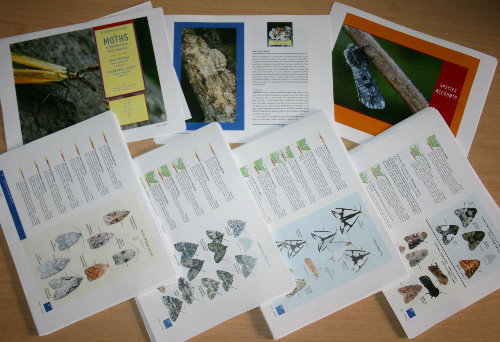
…I’ve been hard at work on the moth proofs. I’m at 45 hours (and counting) spent bent over my drafting table, red pen in hand. Most of these hours have been spent in drawing in the arrows that I dearly hope all you good folks are going to make effective use of in identifying your unknown moths. Doing it forced me to really pause and think about what features I refer to when I recognize a species, how it is I know a species is what it is and not something similar. I’ve learned some interesting and, on occasion, surprising things about the identification of even the moths I’m already familiar with.

White Underwing

…I’ve been setting out my moth light most nights it’s warm and dry enough. Trying to lure in some interesting species so I can take their photos to include among the selection we’ll send to our book’s designer for use on the title pages. We sent them some already, but they turned out to mostly be the wrong orientation. A few nights ago I had some eight underwings come in, half of which were White Underwings like this guy.

leaves

…the leaves have been turning. In the past few years our autumn colour has peaked around Thanksgiving weekend, which here in Canada is the second weekend of October. Next weekend, this year.

fall trees

But it feels like our trees have already peaked. There were vibrant colours among our fields last week, which I’d appreciate when I took the dogs out for some exercise and so I could straighten my back for a brief period.

fall maple

I wonder if it’s because of how dry and sunny it’s been this year? There seem to be a whole lot more reds than there were the year before. The maples in our yard have turned fairly orange, but last year they seemed more yellow (though maybe it’s my imagination). Reds are controlled by light levels and temperatures (I explained the process in more detail in this post), with bright, cool days producing the most colour, so perhaps. The cool weather has definitely arrived, though we managed to hold off our first fireplace fire (the sole source of heating for our home) until October 1, which I thought was doing better than usual.

Milkweed snow

…the milkweed has peaked, too. We had a stretch of beautiful sunny days where all the pods seem to split and the fluffy seeds puffed out, waiting to catch the wind. I couldn’t resist kicking at the stalks as I passed, spreading the down in a snowy blanket across the grass.

Tiny Woolly Bear

…and the Woolly Bears have started trundling from the plants where they grew up to look for a spot to spend the winter. This has got to be the tiniest Woolly Bear I’ve ever encountered. I presume he’s very young, relative to most of the ones I find. I hope he finds someplace cozy

PFG to Moths, status update 2

Back in May I posted a status update on the Peterson Field Guide to Moths of Northeastern North America. Then, we’d just received the bits and pieces of the manuscript, all 4.5 inches worth of printed paper, with notes from our copyeditor. We went over all her corrections, made changes and additions as necessary, and sent it back. The good folks at Houghton Mifflin have been hard at work in the intervening months; in addition to creating the cover, the designers have been busy laying everything out into actual book format. We’ve had some back and forth as questions popped up, and got to see a couple of preliminary pages, but today UPS came by and I got to hold the very first printed proofs of the guide. Looking like a book. How awesome is that? Happily, today’s stack of paper is only 1.5 inches tall. We’ll go through the pages, mark in any changes or adjustments and send it all back again – and the book will be one step closer to being in your hands!