

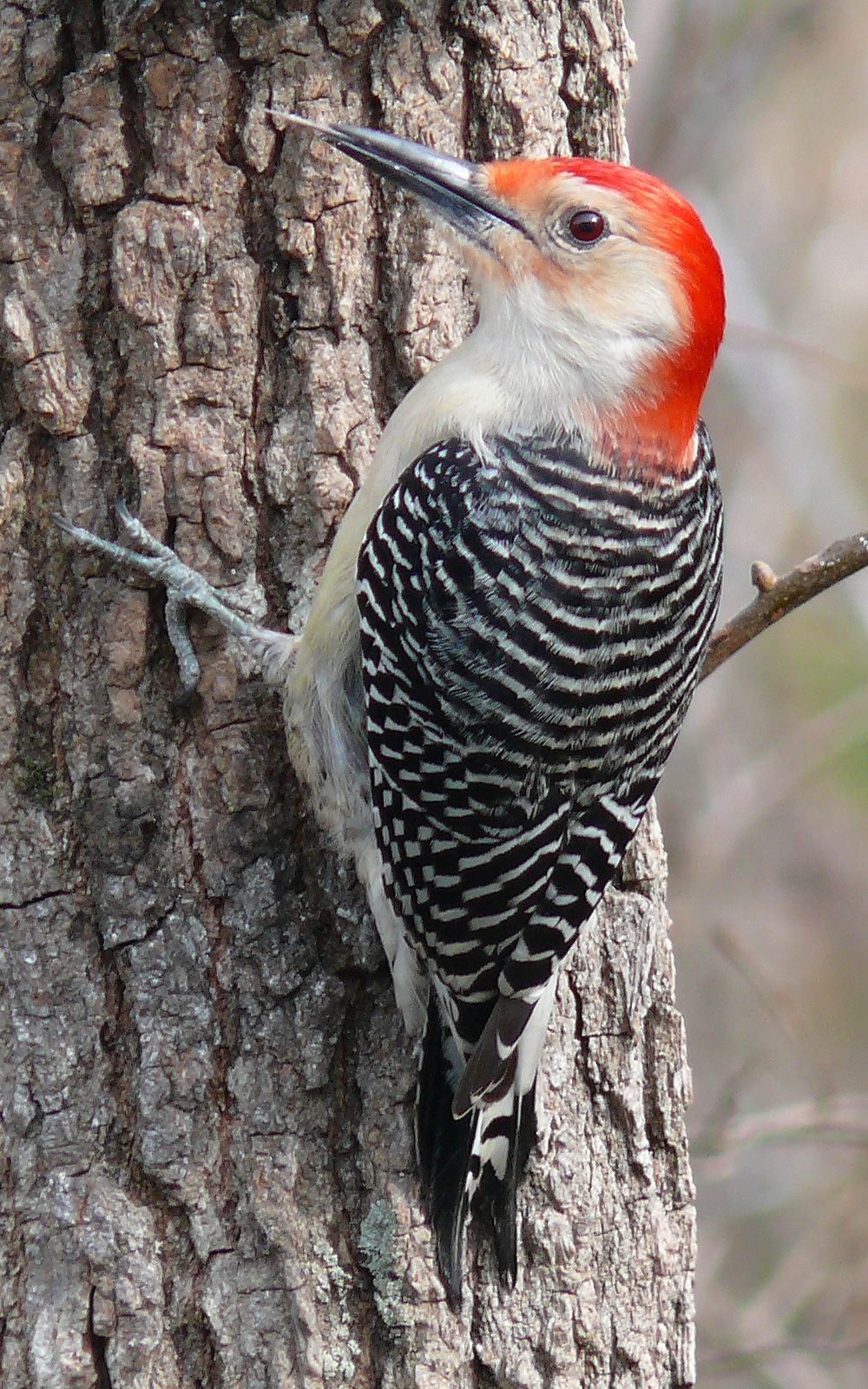
There are a remarkable 22 species of woodpecker in North America. I have seen 15 of these in my travels, the ones I’m missing being mostly southern US species. In Ontario, because of the province’s wide range of latitudes and habitat types, we are lucky to have 9 species. We’ve had 6 of these in our yard, with the remote possibility of another two. The ones we’ve tallied, in descending order of size, are Pileated, Northern Flicker, Hairy, Yellow-bellied Sapsucker, and Downy. The most recent addition to our list was the above, Red-bellied Woodpecker. This one showed up at our feeders for the first time a couple weeks ago, and has continued to visit, on and off, since.

There are three species who sport this combination of pale front and black-and-white ladder-striped back: Gila, Golden-fronted and Red-bellied. The Gila is found in the Sonoran Desert in the southwest and takes its name from the Gila river basin, which covers most of the US portion of the bird’s range. The other two species are somewhat obscurely named, however. There are quite a number of species in North America (and elsewhere) whose name reflects early ornithology practices. In the days before good field optics, most birds were shot in order to be examined. Many birds show subtle characteristics that, when in the hand, seem much more obvious. The ring around the neck of a Ring-necked Duck would be one. Another is the red belly of a Red-bellied Woodpecker. Really, the species would have been more accurately named Rose-vented Woodpecker, as the red tends to be pale, and restricted to the area between and behind the legs. It’s true it does have a red wash to its underside, but if a woodpecker was to take the name of red-bellied it really ought to be the Lewis’s Woodpecker of the west, which really does have a red belly (which, along with its green back and bright red face is North America’s gaudiest woodpecker). The Red-bellied’s scientific name is Melanerpes carolinus, so maybe the best common name would have been Carolinian Woodpecker, doing away with visual cues altogether.

Indeed, the Red-belly’s range in Ontario is largely restricted to the Carolinian forest regions in the very south, though in North America it is quite widespread, found south to Florida and west to eastern Texas and South Dakota. The species has actually been expanding its range north in recent years, perhaps due partially to warming winters associated with climate change and a greater abundance of bird feeders, and also likely due to reforestation of previously cleared areas. The second edition of the Atlas of the Breeding Birds of Ontario showed a 250% increase in the woodpecker’s range in the province. Virtually all of this increase took lace in the southwestern part of the province (which remains the species’ stronghold here), but there are scattered records throughout the region south of the Shield, as far north as Manitoulin Island. Dan submitted this record to the Kingston Field Naturalists’ compiler, who indicated that while the birds are common enough down on the lakeshore, anything north of the city is considered a rare record. So it’s great that we’ve actually got one coming to our feeders. 20 years ago you wouldn’t’ve found them in this region.

Red-bellies are birds of the deciduous forest, rarely found in strongly mixed landscapes, and tending to prefer regions with lots of oak. They require mature forest tracts, with large trees and many dead snags for foraging and nesting. Its nests are usually placed in dead limbs of live trees, which usually means the trees need to be substantially large to have big enough branches to house a woodpecker family. The area around here is ideal for them, with wide expanses of deciduous forest and oak a predominant species in the woodland. It’s probably only recently started to become mature enough, however; many of the trees are still fairly narrow in diameter, and if it is, as I guesstimate, only 60 or 70 years old that would make sense. A recent study showed that the smallest tree used for nesting had a diameter of 21 cm (8.5 inches) but the average was 48 cm (19 inches).

The species is a generalist forager, eating the usual insects and spiders, but also including a lot more seeds, nuts and fruit than other woodpecker species. It’s opportunistic, and will even take bird eggs or nestlings if it happens upon them. One tends to think of woodpeckers as eating ants or grubs from trees, so such a diet is a bit startling. The bird that’s been coming to our feeders has ignored the hanging suet that the Hairy and Downy woodpeckers favour, instead visiting the platform feeders to take the sunflower and other seed that’s spread out there. I recently bought some commercial suet that sits on the platform feeder and which the bird has taken much interest in, as well.

We have put our nets out near the feeders a few times, looking to band some of the birds coming to our feeders so we can see how many birds we have, how well they survive the winter, and other related data (see this post for more on the banding projects). We happened to catch this bird on one of the days, and you can see it sports the band on its right leg. The bird is a female, as determined by the lack of red on the top of the head. Both sexes have the red down the back of the neck, but the female’s head is gray, while the male’s is red. It gives the female a bit of the look of a bald mullet. The front of her forehead and the downy feathers that protect her nostrils from flying sawdust are also red. She is a young bird, hatched this year. The most obvious way to tell this is by her eye, which is brownish; adults will have striking ruby-red eyes (that’s also a great shot of a male). However, as a bander, with the bird in my hand, I can also look at the relative wear and colour of her various feathers on the wings, as adults show a different pattern than young birds because of the way the different age classes moult.
Young birds will go through a post-fledging dispersal, where they leave their natal territories in search of an unoccupied territory to set up shop. Because Red-bellied Woodpeckers are year-round residents, this either means moving into a territory where the previous resident has died, fighting for and winning an occupied territory, or expanding into a region where there aren’t any woodpeckers yet. This girl is probably doing the latter. Hopefully she’ll stick around till the spring and find herself a mate.

I was watching her as she ate at the feeders, taking off for a nearby tree when the birds all scattered. A few times she purposefully gathered up a bite or two of suet and then took off toward one of two branch snags in our yard. Although I was too far away to really tell, it looked like she was caching the food in a crevice in the snag. Because they are primarily seed and nut eaters in the winter, compared to the arthropod diet of other woodpeckers, they will cache food in easy to access places for lean times (arthropods can be found in dead or decaying trees, but seed and nuts on the ground will get covered up by snow).

Her first choice of cache locations seemed to be one that had already been selected by a Blue Jay. Her arrival there caught the attention of the jay, who came over to check out what she was doing.

He decides that her activities look very suspicious, and he’d better move in to assure that she wasn’t raiding his stores.

Hey! Hey! Those are my seeds, chicky! Get your own!

Tough luck, buddy, finders keepers!

On her next trip back to the cache location, the Blue Jay returned, this time with backup. (You can just barely see the woodpecker’s tail below the perch.) I think she finished hiding her suet and decided not to stick around.

I don’t know why in particular, but Red-bellies might be my favourite of our Ontario woodpeckers. Perhaps part of it lies in how few I’ve seen – perhaps only half a dozen, all told, with another dozen or so heard calling but not seen. Of course, that’s not the whole story, because if it was simply scarcity then Black-backed or Red-headed Woodpeckers ought to rank high. They seem to have more personality than many of the other species, I think. She was a very obliging subject today, coming to the feeder frequently and hanging about the yard when she flew off. I shot so many photos, eventually I had to put my camera away so that I wouldn’t be tempted to pick it up and run off a few more when she returned to the feeder again.