The Marvelous in Nature

Seabrooke’s Bookshelf – The Bluebird Effect and Moth Catcher

First, another update on the moth guide. Many bookstores and retailers have already received and put out their copies of the guide, so the book is officially NOW AVAILABLE! I’ve also heard that Barnes & Noble has started shipping online orders; not sure about Amazon. I believe some retailers outside of the northeast won’t be selling the book till April 17, but presumably Barnes & Noble will still ship there now. One way or another, though, you should be able to get your hands on a copy quickly, if you want one!

For those who have ordered a signed copy from me, I’m afraid I’m still operating on an April 17 release-date schedule – not anticipating bookstores to get or put out their copies early. I will be trying to get the books out as soon as I can, but please expect it to still be another couple of weeks. Sorry about that!

Now on to a couple of other titles recently added to my bookshelves…

——————-

The Bluebird Effect by Julie Zickefoose

I received this book the same day I got my first copy of the moth guide, about a month ago. At the time it was an advance copy, before the book was available in bookstores. It’s been released since then, so you should be able to find it now.

I’ve been a follower of Julie’s blog for about five years now, having found it shortly before starting my own (hers was, in fact, one of the blogs that inspired mine). Not long after I discovered her blog, and without realizing I was already a fan of hers, my mom gave me a copy of her first book, Letters from Eden, for Christmas. I read that book in just a couple of days, immediately after Christmas. I’ve been looking forward to Julie’s new book pretty much since finishing that last one. It’s been a labour of love for her, the work spanning nearly as long as it took us to do the moth guide. But for all of Julie’s fans, it’s been worth the wait. The book was recently selected as Book of the Week on Oprah.com, and it’s easy to see why.

The Bluebird Effect is a collection of essays on the many different birds that have touched Julie’s life over her years as a birder and rehabilitator, starting with a male bluebird her husband saves from a local Sharp-shinned Hawk one day, and who thanks her by returning year after year to nest in the boxes in their yard. The title is drawn from the idea of the butterfly effect, applied to this bluebird; both in terms of the bluebird’s own effect on his local world through the young he raised, and his effect on Julie as she watched him and got to know him.

The narrative is easy to read, picking you up and pulling you in with that same poetic quality that fills Julie’s blog. But of course, what makes the book so unique are the hundreds of watercolour paintings and pencil sketches that fill the pages, illustrating her stories. She’s got a distinct style to her artwork, managing to capture the essence of a bird in just a few quick strokes of the pencil or brush, a skill I’ve long admired.

The stories recount the close encounters of the avian kind that Julie’s been lucky enough to experience in her years of working with birds, and it’s impossible not to come away from them without an understanding of the reason she gives up her time (sometimes lots of it!) to helping these individuals. I think this excerpt from a chapter on a Red-tailed Hawk sums it up well:

[O]pening the door into his life, if only for a little peek, brought home to me that almost everything in nature is so much more awe-inspiring than it first appears. … I thought about those who would question whether one middle-aged redtail was worth all the fossil fuel and frozen mice, man-hours, phone minutes, medical expertise, and X-ray film expended on his behalf. I’d argue that he was worth all that and more. Though it would not matter to him, in the Ohio countryside beneath his outstretched wings, he’d left a handful of human hearts, connected in joy.

———–

Moth Catcher by Michael M. Collins

I was contacted by Michael Collins a while ago asking if I’d be interested in a copy of his book. Never one to turn down a free book (and this one had the promise of moths!) I said sure, I’d love to see it. It arrived not long after, and I had a quick flip through then set it on my shelf. I’ve been on a fiction binge lately and haven’t been in the mood for non-fiction (Julie’s book being the exception). Finally, earlier this week I finished up my most recently library novel and, not really being grabbed by any of the other titles waiting for me on my shelf, I decided to give this a go, since I’d promised Michael I’d review it. I’ll be completely honest: I was planning to read the first 40-50 pages or so, enough to get a feel for the book so I could post something here, and I could maybe come back to it at a later date.

Well, I finished it in three days. Admittedly, it’s not a long book at just over 160 pages, and small pages at that. But that’s unfairly dismissive of the writing, which was very engaging. I had been expecting the book to be mostly about the capture and rearing of silkmoths, which was sort of how it had been described to me (not to mention what the title infers). But it’s not really about that at all, though that’s sometimes touched on; it’s more about hybridization of species in nature, with moths playing the research subjects, and showing how the author’s early interests helped influence his choice of species and location for his work.

The book falls into three sections. Chapters 1-3 are all a sort of personal chronicle of his boyhood (including a recipe for his neighbour and friend’s mint sauce), and then his experiences hiking the canyons and mountain passes of the book’s subtitle. This was definitely my favourite section of the book, taking me back to my three weeks spent on an ecology field course in the deserts of Arizona and California one year, and to my summer doing bird surveys in the Sierra Nevada mountains around Lake Tahoe. Even without this personal experience, though, the pictures Michael draws of these regions should bring you right there with him.

In chapters 4-6 Michael starts to focus more on his graduate research looking at hybridization in the mountain passes where two closely related silkmoth species from either side of the mountains come together. These are also fascinating as he talks about collecting species and looking at the different mechanisms he discovered that maintain the two species as separate. And finally, in chapters 7-8 he discusses the science of hybridization in a broader sense, drawing on his own work and that of one of the inspirations for his graduate studies, Walter Sweadner. While still interesting, I did feel the book started to bog down a bit through these sections as the narrative gets more scientific and less personal, and found myself skimming the text in spots.

Still, I found the book to be a light, easy read, and would definitely recommend it for anyone looking to learn more about silkmoths, the southwest, or species hybridization.
A quick note re: the moth guide

Currently Amazon lists a Kindle edition of the PFG to Moths as being available for pre-order with release on April 17. I inquired with our editor about this, and there will be no Kindle/ebook edition released anytime soon. The field guide format is trickier and more involved to convert to ebook than a standard narrative/text, and the tools to do a good job of it are fairly new. The way the information is stored in the computers is apparently a little confusing and results in Amazon putting this sales link up (I gather this has been a problem for a while and the publisher has been looking at changing the computer system to try to address it).
There may well be an ebook version in the future, but it won’t be available on April 17. So if you’ve pre-ordered a copy, you’ll need to cancel and order the print copy instead. Sorry about that, everyone!

Snake Love

snakes1

A couple of weeks ago most of the northeast enjoyed a long stretch of very unseasonably warm temperatures. Here in eastern Ontario we had nearly a week of days above 20°C (68°F), a couple of times warm enough that my winter-acclimated body started protesting the “heat” (comes mid-summer, I’ll be laughing that I found this temperature hot). But it was glorious, from a recreational perspective. I’ve been busy wrapping up a couple of work projects, but I made sure I took some time to get out and enjoy the weather every day.

From an ecological point of view, I’m curious to see if the early spring will cause serious disruptions. The warm temperatures were sustained long enough to trigger trees and shrubs into leafing out about two weeks ahead of schedule; our garden crocuses are bloomed and done already, when last year they didn’t even flower until April 9. It feels like mid-April out there, which has been a little disconcerting the last few days while it’s still been March.

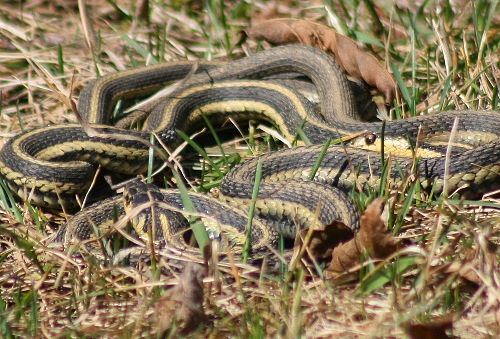
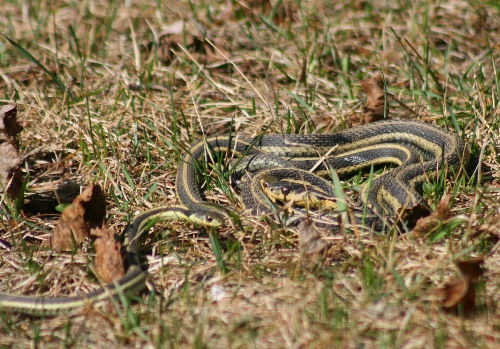
And speaking of early things… One afternoon Dan pointed these snakes out to me. They were writhing in a small pile on our lawn. I’d never seen this behaviour before but I knew immediately what was going on, so I grabbed my camera and went out to try for a few photos.

snakes3

It was a mating ball, of course. Male snakes emerge first, in the early spring, as temperatures begin to rise and the hibernacula where the snakes spent the winter begin to warm. Usually a couple of weeks after the first females begin to come out. She broadcasts a pheromone as she goes about her routine, which very quickly attracts nearby males.

She’s often noticeably larger than the males are. In the photo above, she’s the darker olive-yellow individual on the left, and the brighter yellowish head on the right belongs to a male (the male, in fact; by the time this photo was taken, they were copulating).

snakes2

The females are a scarce resource, and males literally wrestle over who gets to court her. Sometimes a dozen snakes or more can form a writhing mass of bodies with the female somewhere in the middle of it all. That’s what was going on when Dan first spotted it, I think. By the time I got out there with my camera, one male had come out the winner.

As I stood there snapping photos, a few hopeful males, late to the party, slithered in, checked out the situation, then slithered away again without joining in. I recall reading that the males track the pheromone left behind on the ground as the female slithers, so I’m thinking maybe these males have followed her scent trail only to find, once they finally reached her, that she was no longer broadcasting the pheromone. Or maybe she starts broadcasting a different one that says, “Sorry boys, I’m taken”? Perhaps the successful male gives them a fierce look that says, “Don’t you dare lay a coil on my girl”? In any case, none of the newcomers even bothered making an attempt to join her.

snakes4

Though I didn’t notice any reference specifically stating so, I assume the successful male is the one who manages to get his hemipenis positioned and inserted into the female first, rather than winning any sorts of one-on-one battles with the other males the way (say) rutting deer do, or winning the female’s favour the way (say) displaying prairie-chickens do.

The hemipenis of snakes is sort of sac-like and usually held within the body, but expands and everts when the male is preparing to mate. In many species it has barbs or hooks that make it difficult to remove it from the female while it’s everted. Once it was just down to the two mating snakes, after a few moments the female decided she wanted to leave and started slithering away; but the two were still joined, presumably because of these barbs, and I got a look at the copulatory site as they twisted their bodies about. The female is the upper, duller snake in this photo, the male the lower, brighter one. They quickly disappeared into the long grass so I didn’t see what happened after that.

So that was kinda cool! Spring continues to march onward here, which is giving me lots to look at and (hopefully!) lots to post about. Stay tuned!

March Moths (and a few PFG to Moths plates)

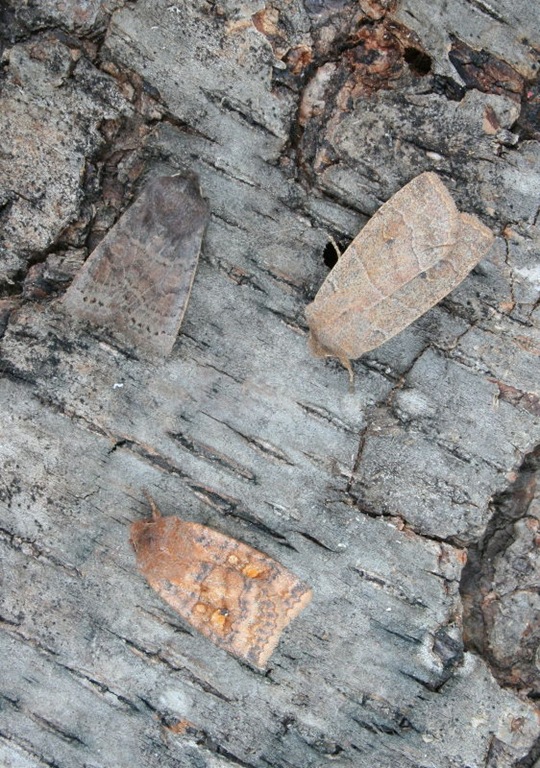
Goat Sallow - Morrison's Sallow - Three-spotted Sallow

With the gorgeous weather yesterday, I knew there’d be moths flying come evening. I put my mercury vapour light out, even going to the trouble to dig out and pin up my white sheet in front of it. And I wasn’t disappointed! I got a great diversity, 15 macromoths of 11 species, and another dozen or so micros of the agonopterix and acleris variety.

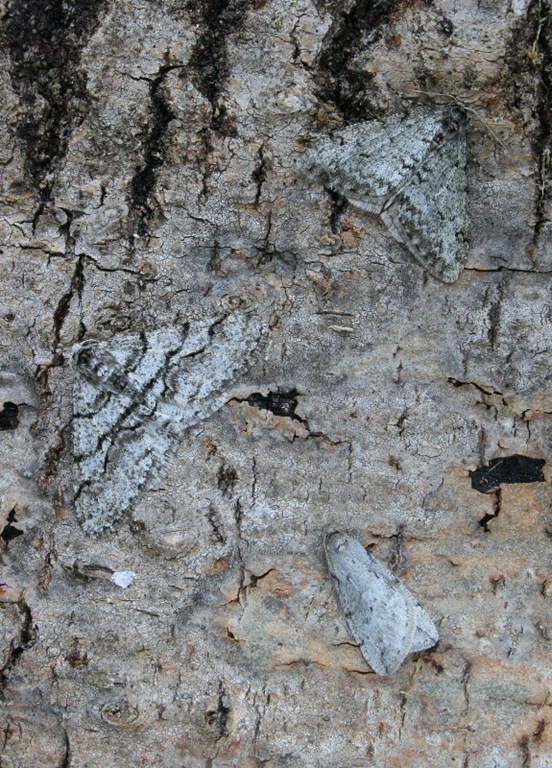
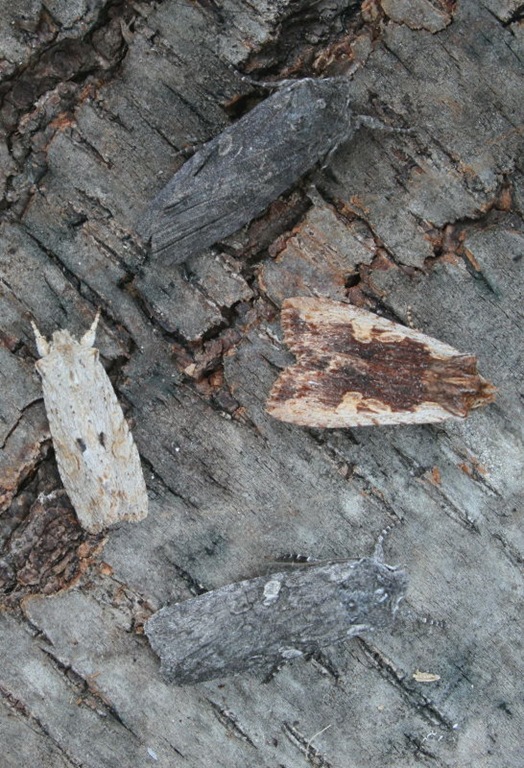
I collected up one individual of every species except the Straight-toothed Sallow, which was the First Moth of 2012. The top shelf of the fridge was satisfyingly crowded. Since I’ve already got dozens of photos of these species on the plain background I usually use for species portraits, I thought I’d do a collage, in groups.

The above group is all the sallows (again, minus the Straight-toothed, which I sort of wish I’d brought in just for completeness). Top left: Goat Sallow, Homoglaea hircina; top right: Morrison’s Sallow, Eupsilia morrisoni; bottom: Three-spotted Sallow, Eupsilia tristigmata.

Small Phigalia - Half-wing - Spring Cankerworm

There are three early-spring geometers that you can pretty much count on on any given night in March and early April. I was pleased that all of them turned up last night – just singles of each. Top to bottom: Small Phigalia, Phigalia strigataria; The Half-Wing, Phigalia titea; and Spring Cankerworm, Paleacrita vernata. Having this photo with them all in the same shot helps emphasize the size difference between Small Phigalia and The Half-Wing.

Dowdy - Dimorphic - Hemina - Grote's Pinions

And finally, the pinions. The third group of overwinterers who’re likely to come to lights early in the season. I was surprised there were so many species last night, ordinarily I just get the bottom one here. Top: Dowdy Pinion, Lithophane unimoda; middle left: Dimorphic Pinion, Lithophane patefacta; middle right: Hemina Pinion, Lithophane hemina; bottom: Triple-spotted Pinion, Lithophane laticinerea.

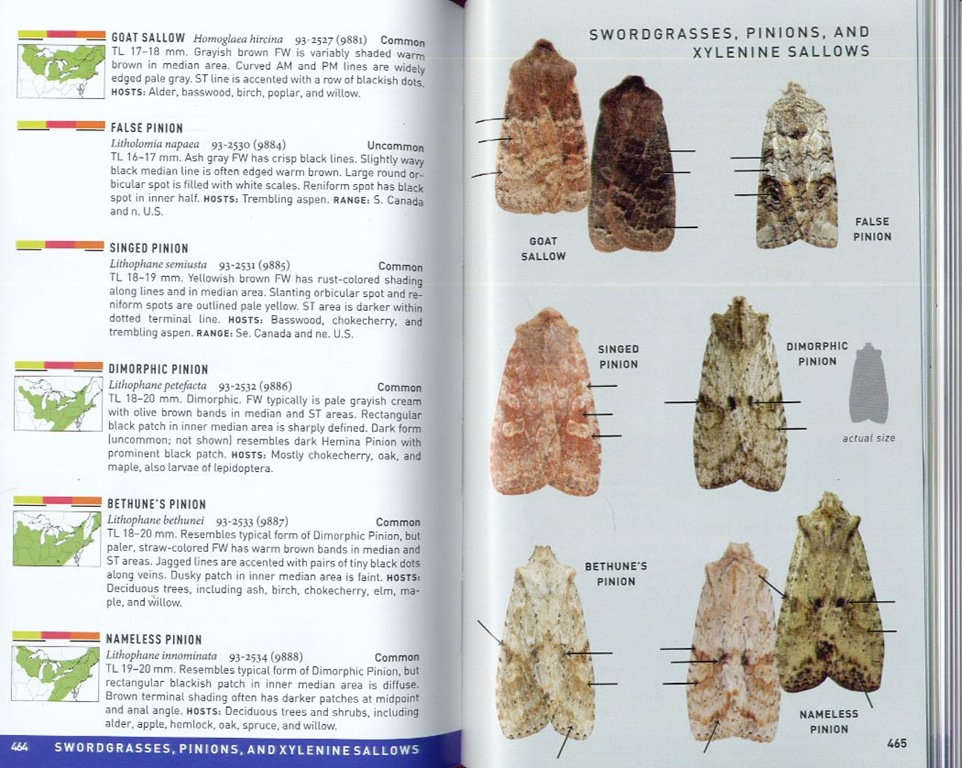
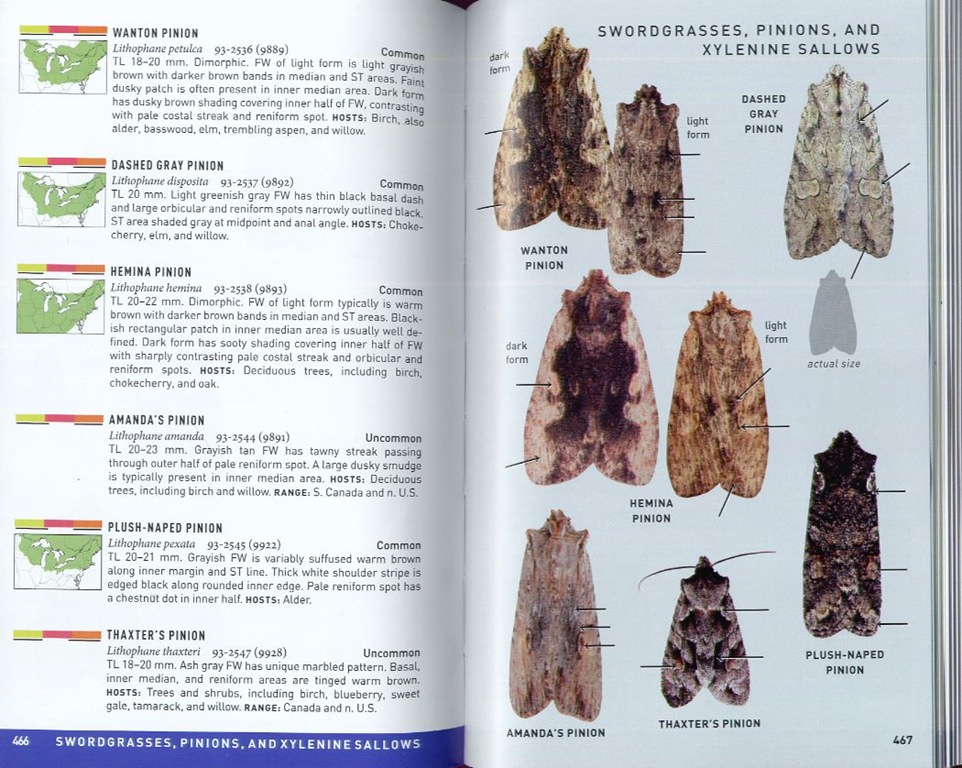
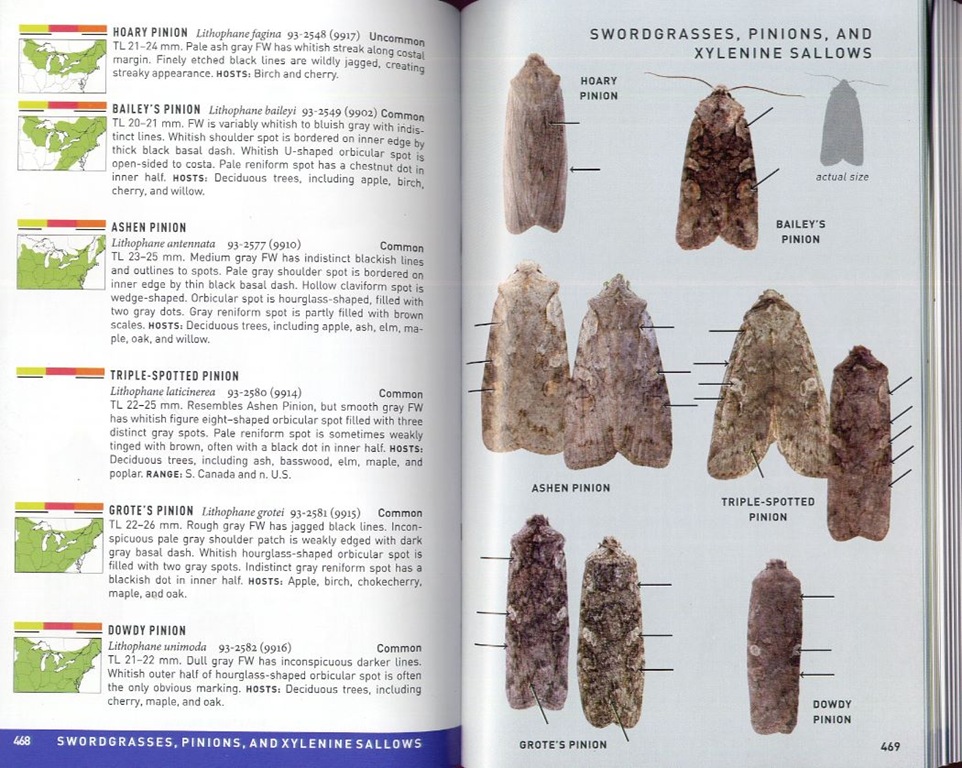
These guys have distinctive shapes and so are easy to pick out, usually. There are two shape types: the long, narrow gray ones, and the bow-winged (look at the outer edge), shoulder-padded ones. Within each of the shape groups there are a number of look-alike species. For instance, Hemina and Wanton Pinions look very similar, but Heminas tend to be orangier with more diffuse markings than the grayer Wantons. Likewise, Grote’s and Triple-spotted can be hard to tell apart, but Triple-spotted typically are a smoother gray with the ST line often sparser/dotted or nearly absent compared to the rougher-gray Grote’s.

Since we’re still a month out from the release of the moth guide (but only a month! April 17!) but the pinions are flying now, I thought I’d scan in and post the identification plates for the group. Enjoy!

For all of these, click on the image to see a larger version.

Pinions1

Pinions2

Pinions3

Cats / tracks

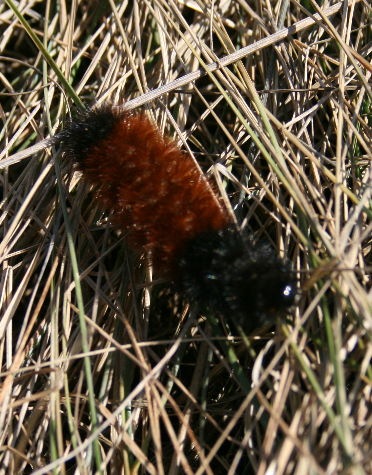
woollybear

I’ve been waiting for a really nice, sunny, mild day to head out with my cordless drill to clean out our nestboxes, and the weather conditions were perfect for it this afternoon. I took photos and will follow up on that on probably Wednesday.

While I was out there, though, I saw a number of other critters enjoying the sunshine like I was. I spotted a few fuzzy caterpillars, mostly Woolly Bears like the above. They emerge so early, I don’t actually know if they spend any time eating before they pupate. There wouldn’t be a whole lot to eat yet. Although, I did spend some time raking out our garden, and the first shoots of daffodils and croci are coming up, as is the rhubarb. And quite a number of plants stay evergreen under the snow. So maybe there would be enough.

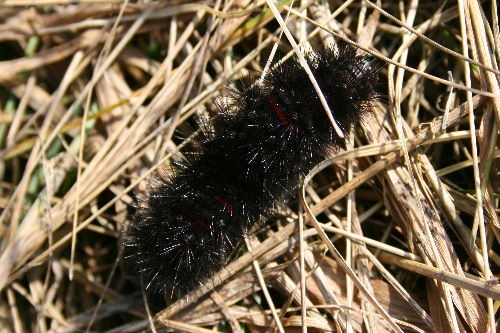
giantleopardcat

On the way back to the house I came across this guy, who I initially mistook from a distance to be another Woolly Bear, but who turned out, upon closer inspection, to be a Giant Leopard Moth caterpillar. I still get inordinately pleased whenever I discover one of these guys, even though they’re not uncommon here. We didn’t have them where I grew up (or if we did, I never noticed them); it wasn’t till I moved east that I started seeing them. So I still get that thrill of somethingcool! when I find one.

As I was walking back from the last nestbox I noticed a robin off some distance away in the forest, making a lot of noise in the leaf litter. I’d brought my binoculars with me (something I don’t always do, since I do most of my birding by ear these days and it’s one less thing to carry around) so I was able to watch him closely. After a moment or two he picked something up, dark and thick and C-shaped, carried it a short distance, then plunked it down in the leaf litter. I’m fairly certain it was a dark fuzzy caterpillar like one of the two above. I think he might have been trying to de-bristle it prior to eating it.

track1

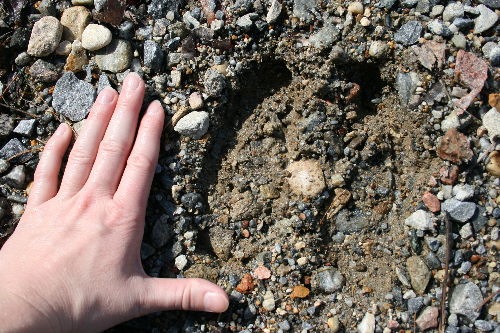
I made a brief detour out to the rail trail and walked down to the creek, and discovered these tracks out there. What first caught my eye was the size of them. Certainly much bigger than any deer I’d seen around here. They’re cloven like deer and domesticated ungulates (except horses/donkeys), but there was really only one animal I thought could make something that large, at least that I would reasonably expect might be found walking down the rail trail. Which is a moose, of course.

track2

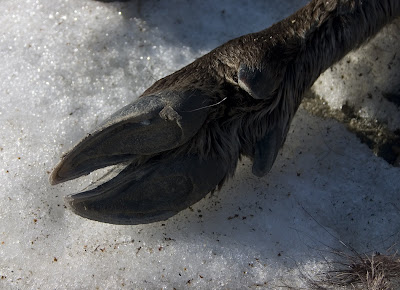
Having seen a moose in our back fields last fall, this wasn’t quite the stretch that I might have otherwise thought it. It’s possible he’s hung around the area, in one of the swamps nearby, keeping out of sight. I took a few photos and double-checked my tracks guide when I got back. They seem to be potentially confusable with domestic cows, with the main distinguishing feature being the front of the track – the hooves are pointed in moose, but rounded in cows.

You can’t see it as well in the first photo, but you can tell in the second that the front of the tracks are pointed. It was pretty clear in person, too, that the paired hooves were long and tapering at the front. They were relatively fresh… I didn’t notice them on my way out, only on my way back, though that’s not to say that they weren’t there and I just missed them on the way out. I tried following them to see where they went, but they seem to curve out from the fenceline and then back into the fenceline. I can only presume he jumped the fence, then got spooked after walking only a short distance down the trail and jumped back. And yes, moose, like all deer, can jump:

Who Knew? - Moose Jumping a Fence Photo by Bruce Barrett (nordicshutter) on Flickr; CC-licensed (the only such photo I found of a moose jumping, though there are others that are not CC)